Florida's 15 General Officers
Florida provided fifteen general officers to the Confederacy. Some of these men had been professional soldiers but most were not. Some were born in Florida and others came to Florida from the states to the north; one even coming from Ireland. Florida's generals fought in all of the theaters of the war, from Virginia to Arkansas and Kentucky to Florida. One was the fifth highest ranking officer in the Confederte Army and one received his general's commission just days before Lee's surrender at Appomattox.
We will begin to list all of Florida's generals with a short biography on each.
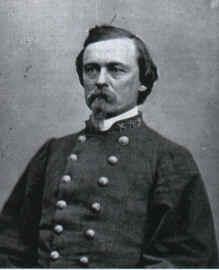
Finegan wears the collar insignia of a Colonel, though he was directly commissioned a Brigadier General.
Brigader General Joseph Finegan
"Finegan, me bye, ye know ye are yur mither's darlin'." Thus is recorded just one example of the colorful dialect of this native Irishman, born November 17, 1814 at Clones, Ireland. Like thousands of other sons of Eire, he immigrated to the United States in the 1830s, settling in Florida near Jacksonville, where he quickly became a prominent member of the community, operating first a small plantation and later a sawmill. A few years later he removed to Fernandina and began a long and useful association with the influential politician David Yulee, later senator from Florida. Together they commenced construction of a railroad, and Finegan's own importance rose in tandem with Yulee's.
Thus when the state secession crisis loomed, Finegan served as a member of the 1861 state convention that on January 10 voted to withdraw from the Union. For reasons that are unclear, given Finegan's complete lack of military training or experience, Governor John Milton put him in charge of the state's efforts to get onto a war footing. This, plus the political necessities of appointing a sufficient number of brigadiers from Florida, induced President Davis to tender Finegan a commission on April 5, 1862, to take rank immediately. The Senate confirmed the appointment the same day, and Finegan himself accepted it on April 17, thereby becoming one of the senior officers to be appointed from his state.
On April 8, 1862, Finegan took command of the Department of Middle and Eastern Florida, which he held for the next two years. It was a backwater command, largely of importance only for protecting the long coastline, and raising troops, often for service elsewhere.Soon after Finegan took command, R. E. Lee complimented him on his zeal and productivity at organizing Floridians into companies. Lee was also encouraged by Finegan's very realistic-and all-too-unusual-attitude that only as many state troops as necessary should be kept in Florida, while the majority should go to the main army in Virginia. Finegan's suggestion may have been prompted by a desire that he himself should be reassigned to the main theater of operations, but Lee believed that he could not be spared from Florida.
Finegan would start to see action in his own front later in 1862, as Federal incursions into Florida brought the war to him. While keeping his headquarters at Tallahassee, he oversaw the defense of Tampa in the summer and in September took and occupied Saint John's Bluff. In March 1863 he captured Jacksonville and held it briefly. His great moment, however, came at the Battle of Olustee, when Federals under Truman Seymour made a landing at Jacksonville and moved inland. Finegan assembled hastily the troops of his department and on February 20, 1864, delivered a telling attack that halted the enemy advance and sent Seymour back in retreat.
It was possibly the success at Olustee, combined with the confidence that Lee had expressed earlier in Finegan that led the Virginia chieftain on May 16 to ask the War Department to have a brigade made up of available Florida troops and sent to him, with the Irishman in command. Gathering forces from all points to resist Grant's advance, Lee needed the man from Florida.
"Marse Robert" was not to be disappointed. Finegan arrived in time to hold a critical point in the line at Cold Harbor on June 3. When the Federals briefly broke through, Finegan's brigade rushed into the gap, and quickly plugged it once more, winning compliments from many quarters. Thereafter he remained with the Army of Northern Virginia, his brigade soon being reassigned to Mahone's Division of the III Corps. Throughout the remainder of 1864 Finegan led the 2d, 5th, 8th, 9th, 10th,and 11th Florida in the trenches around Petersburg.
In January 1865 prominent Floridians petitioned the government to have him returned to their state.Finegan himself, weary after almost four years of continual service without a rest, also asked that he be reassigned, though as always he revealed a spirit of cooperation when he did not request that his brigade be sent with him, knowing that Lee needed it more. On March 20, 1865, he was reassigned to command in Florida. There in May he rendered his final services to the Confederacy when he assisted Secretary of War John C. Breckinridge and Secretary of State Judah P. Benjamin in successfully escaping through Florida to Cuba and the Bahamas,respectively.
Following the war, General Finegan lived in Jacksonville for a time, and then moved to Rutledge, working for a time as a cotton broker, as well as practicing law. He served a term in the state senate, 1865-66, and finally died on October 29, 1885, at Rutledge,and was buried in the Old City Cemetery at Jacksonville. He had shown himself to be one of that class of men who led by raw native good sense. His potential may never have been truly challenged in the Florida command or in his limited field experience in battle, but wherever he served he won the approval of those above and below him.
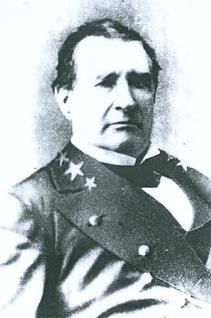
Finley appears older and heavier in this later war image. It shows stars of rank affixed to what is a simple broadcloth suit. It is possible that they are an artist's addition.
Brigader General Jesse Johnson Finley
The son of a wealthy planter, Finley was born in Wilson County, Tennessee, on November 18, 1812. He was educated at an academy in Lebanon before he read law in Nashville. After being admitted to the bar, he opened a law office in Lebanon. During the Seminole War of 1836, Finley organized a company of mounted volunteers and was appointed captain. He served inFlorida for two years, returning to Tennessee in 1838.
Moving often over the next few years, Finley continued to practice law and became very active in politics. In 1841 he was elected state senator from Mississippi County, Arkansas, but resigned his seat in 1842 and moved to Memphis, Tennessee. There he was elected mayor in 1845, but in 1846 moved again to Marianna, Florida. Finley was elected a Florida state senator in 1850 and in 1852 served as a Whig presidential elector. From 1853 to 1861 he served as a judge for Florida's western circuit.
After Florida seceded in 1861, Finley became a Confederate district judge but resigned that post in March 1862 to enlist as a private in the 6th Florida Infantry. Probably because of his political prominence, Finley quickly rose to captain and then to colonel of the regiment.
Attached to Col. W.G.M. Davis' Florida Brigade in eastern Tennessee, the regiment invaded Kentucky with Florida General Edmond Kirby-Smith's column during the late summer of 1862. Following the invasion, Finley oversaw the department's court-martial at Knoxville, Tennessee.
Finley's first real combat experience came atChickamauga, where his regiment was in Colonel RobertC. Trigg's brigade. On the afternoon of September 19,1863, the brigade was ordered to support an attack by John Bell Hood. The order to advance somehow miscarried, and Finley soon found himself several hundred yards ahead of the rest of the brigade. Nonetheless, the 6th Florida broke through one Union line and captured a battery of artillery. However, being unsupported, Finley was forced to withdraw after suffering the loss of 165 men. Trigg wrote of Finley's command, “The fortune of war threw the Sixth Florida Regiment into the post of danger and upon them the heaviest loss, and proved them veterans in their first fight.” On the next day Finley again drew praise when he led the 6th Florida and 54th Virginia in a charge against a Union position and captured five hundred prisoners.
On November 8, 1863, Finley was promoted to brigadier general, to rank from November 16, and given command of all the Florida infantry in the Army of Tennessee. He apparently was taken aback by the promotion and wrote Jefferson Davis to assure the president he did not seek the rank. Davis wrote Finley on December 16, "The fact that you did not seek the appointment conferred upon you, and your diffidence in assuming its responsibilities, is to me additional evidence of your fitness to command. I shall but the more confidently rely on one who, ready to serve, does not aspire to command."
Finley's new brigade was placed in line with Braxton Bragg's army near Chattanooga. When theFederals broke through the Confederate line atMissionary Ridge on November 25, 1863, Finley'sFlorida brigade performed admirably in rear guard action while the army escaped. Bragg said, "I cannot, in justice to the generous and brave, consistently closethis without expressing my thanks to BrigadierGeneral Finley for his gallant bearing and prompt assistance in every emergency."
The winter was a severe hardship for Finley's men. In February 1864, the officers of the Florida Brigade forwarded a petition to Finley to be sent to Congress. The officers attached a list showing the outrageous prices they were forced to pay for food and clothing and declared they could not survive on the meager pay allotted them. Finley supported his officers, endorsed the petition, and forwarded it to his superiors, but apparently no action was taken on it by Congress.
During the Atlanta Campaign, Finley's brigade was still in Bate's Division of William Hardee's Corps. Finley saw heavy fighting in the campaign, but there is little official documentation of it. At Resaca he was badly wounded and put out of action until the army reached Atlanta. Then at Jonesborough shell fragments killed his horse and severely wounded him again,but he refused to be evacuated to Atlanta until all of his wounded men had been removed. Because of this sense of duty, he missed the last evacuation train, and was finally slipped through roving bands of Yankees and back to the hospital in a wagon.
Finley was separated from his brigade for the rest of the war. He tried to rejoin his unit in North Carolina after recovering from the second wound, but Federal troops blocked his way. He therefore reported for duty to Howell Cobb at Columbus,Georgia, and surrendered there with Cobb in April 1865.
Finley settled in Lake City, Florida, after the war and resumed his law practice. He later moved to Jacksonville in the 1870s. Finley re-entered politics and served in Congress from 1875 to 1879 before losing his seat in 1879 in a contested election. In 1887 he was appointed to the United States Senate to fill a vacancy but was refused the seat because of a technicality. Returning to the legal profession, Finley served as a Florida circuit court judge from 1887 to 1903. He died in Lake City on November 6, 1904, and is buried in Gainesville.
Source: Dickison, J. J., Florida, Vol. XI in Evans Confederate Military History.
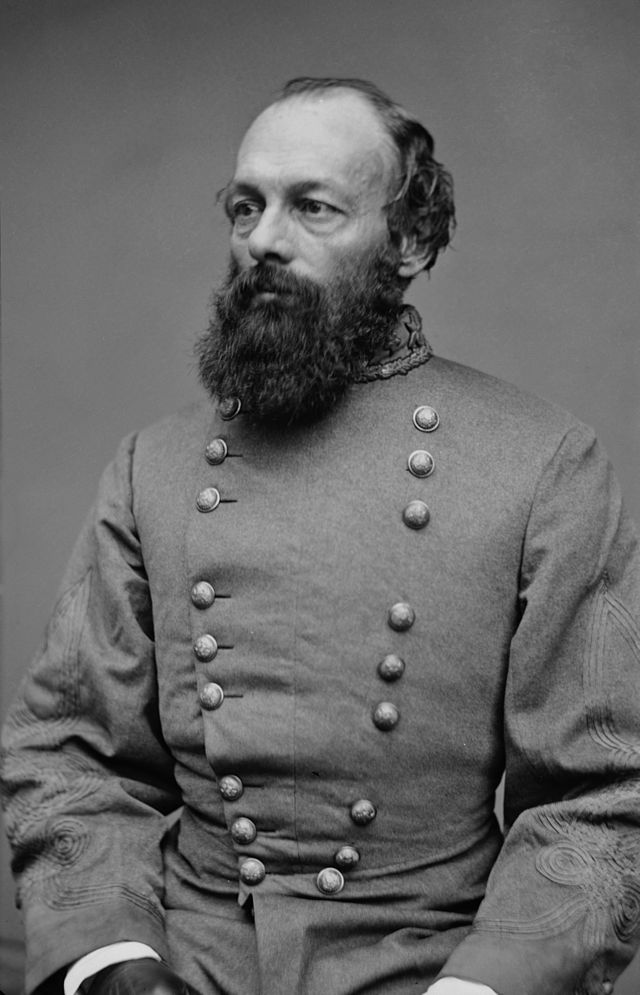
Gen. Edmund Kirby Smith in his uniform photographed just prior to taking command of the Department of the Trans-Mississippi. Image courtesy of Wikimedia Commons.
Gen. Edmund Kirby Smith
Smith was born in 1824 in St. Augustine, Florida, as the youngest child to Joseph Lee Smith and Frances Kirby Smith. Both his parents were natives of Litchfield, Connecticut, where their older children were born. The family moved to Florida in 1821, shortly before the elder Smith was named a Superior Court judge in the new Florida Territory, acquired by the US from Spain. Older siblings included Ephraim, born in 1807; sister Frances, born in 1809; and Josephine, who died in 1835, likely of tuberculosis.In 1836, his parents sent him to a military boarding school in Virginia, which he attended until his enrollment in the United States Military Academy at West Point, New York.
On July 1, 1841, Smith entered West Point and graduated four years later, standing 25th out of 41 cadets. While there he was nicknamed "Seminole" after the Native Americans of his state, and brevetted asecond lieutenant in the 5th U.S. Infantry on July 1, 1845. He was promoted to second lieutenant on August 22, 1846, now serving in the 7th U.S. Infantry.
In the Mexican-American War, he served under General Zachary Taylor at the Battle of Palo Alto and the Battle of Resaca de la Palma. He served under General Winfield Scott later, and received brevet promotions to first lieutenant for Cerro Gordo and to captain for Contreras and Churubusco. His older brother, Ephraim Kirby Smith (1807-1847), who graduated from West Point in 1826 and was a captain in the regular army, served with him in the 5th U.S. Infantry in the campaigns with both Taylor and Scott. Ephraim died in 1847 from wounds suffered at the Battle of Molino del Rey.
After that war, Kirby Smith served as a captain (from 1855) in the 2nd U.S. Cavalry, primarily in Texas. (From that year on through the war, Smith was accompanied by Alexander Darnes, then 15, a mixed-race slave of his family who served as a valet until emancipation. Kirby Smith collected and studied materials as a botanist; like many other military officers, he was also a scientist. Some of the items from his collecting at West Point, he donated to the Smithsonian Institution.
Kirby Smith was assigned to teaching mathematics at West Point, from 1849-1852. According to his letters to his mother, he was happy with this environment. On May 13, 1859, he was wounded in his thigh fighting Indians in the Nescutunga Valley of Texas. When Texas seceded, Smith, now a major, refused to surrender his command at Camp Colorado in what is now Coleman, Texas, to the Texas State forces under Col. Benjamin McCulloch; he expressed his willingness to fight to hold it. On January 31, 1861, Smith was promoted to major, but on April 6, he resigned his commission in the U.S. Army to join the Confederacy.His sister Frances (Smith) Webster remained loyal to the Union although married to Lucien Bonaparte Webster, a Confederate officer, who died during the war.
On March 16, 1861, Smith entered the Confederate forces as a major in the regular artillery; that day he was transferred to the regular cavalry with the rank of lieutenant colonel. After serving briefly as Brig. Gen. Joseph E. Johnston's assistant adjutant general in the Shenandoah Valley, Smith was promoted to brigadier general on June 17, 1861. He was given command of a brigade in the Army of the Shenandoah, which he led at the First Battle of Bull Run on July 21. Wounded severely in the neck and shoulder, he recuperated while commanding the Department of Middle and East Florida. He returned to duty on October 11 as a major general and division commander in the Confederate Army of Northern Virginia.
In February 1862, Smith was sent west to command the Army of East Tennessee. Cooperating with Gen.Braxton Bragg in the invasion of Kentucky, he scored a victory at the Battle of Richmond, Kentucky on August 30, 1862, and was named on October 9 to the newly created grade of lieutenant general, becoming a corps commander in the Army of Tennessee. Smith would also receive the Confederate "Thanks of Congress" on February 17, 1864, for his actions at Richmond.
On January 14, 1863, Smith was transferred to command the Trans-Mississippi Department (primarily Arkansas, Western Louisiana, and Texas) and he remained west of the Mississippi River for the balance of the war, based part of this time in Shreveport, Louisiana. As forces under Union Maj. Gen. Ulysses S. Grant tightened their grip on the river, Smith attempted to intervene. However, his department never had more than 30,000 men stationed over an immense area and he was not able to concentrate forces adequately to challenge Grant nor the Union Navy on the river.
Following the Union capture of the remaining strongholds at Vicksburg and Port Hudson and the closing of the Mississippi, he was virtually cut off from the Confederate capital at Richmond and was confronted with the command of a virtually independent area of the Confederacy, with all of its inherent administrative problems. The area became known in the Confederacy as "Kirby Smithdom".
In the spring of 1864, Lt. Gen. Richard Taylor, directly under Smith's command, soundly defeated Maj. Gen. Nathaniel P. Banks at theBattle of Mansfield in the Red River Campaign on April 8, 1864.[13] After the Battle of Pleasant Hill on April 9, Smith joined Taylor and dispatched half of Taylor's Army, Walker's Greyhounds, under the command of Maj. Gen. John George Walker northward to defeat Union Maj. Gen.Frederick Steele's incursion into Arkansas. This decision, strongly opposed by Taylor, caused great enmity between the two men.[14]
With the pressure relieved, Smith attempted to send reinforcements east of the Mississippi, but as in the case of his earlier attempts to relieve Vicksburg, it proved impossible due to Union naval control of the river. Instead he dispatched Maj. Gen. Sterling Price, with all available cavalry, on an unsuccessful invasion of Missouri. Thereafter the war west of the river was principally one of small raids and guerrilla activity. By now a full general (as of February 19, 1864, one of only seven such men in the Confederacy), he negotiated the surrender of his department—the only significant Confederate field army left—on May 26, 1865. He signed the terms of surrender in Galveston, Texas, on June 2, and afterward fled to Mexico and then to Cuba to escape potential prosecution for treason. In August that year General Beauregard's house near New Orleans, was surrounded by troops who suspected he was harbouring Smith. All the inhabitants were locked in a cotton press overnight. Beauregard complained to General Sheridan who expressed his annoyance at his erstwhile enemy's treatment. Smith returned to take an oath of amnesty at Lynchburg, Virginia, on November 14, 1865.
After the war, Kirby Smith was active in the telegraph business and higher education. From 1866 to 1868, he was president of the Atlantic and Pacific Telegraph Company. When that effort ended in failure, he started a preparatory school, in New Castle, Kentucky, which he directed until it burned in 1870.In 1870, he combined efforts with former Confederate general officer Bushrod Johnson and became president of the University of Nashville.
In 1875, Kirby Smith left that post to become professor of mathematics and botany at the University of the South at Sewanee, Tennessee. Part of his collection from those years was donated to the University of North Carolina, Harvard, the Smithsonian Institution. He kept up a correspondence with botanists at other institutions. He taught there until 1893, when he died of pneumonia. At the time of his death in Sewanee, he was the last surviving man who had been a full general in the Civil War. He is buried in the University Cemetery at Sewanee.
Source: Biography of Gen. Edmund Kirby Smith, Wikipedia
The other Florida generals were:
MGEN William H. Chase
· MGEN William W. Loring
· MGEN Martin L. Smith
· MGEN James P. Anderson
· BGEN James M. McIntosh
· BGEN Edward A. Perry
· BGEN William S. Walker
· BGEN G. M. Davis
· BGEN Francis A. Shoup
· BGEN William Miller
· BGEN Robert Bullock
· BGEN Theodore W. Brevard
The link below will allow you to download a file that has the biography of each of these generals.

|
FloridaGeneralBiography.pdf Size : 400.222 Kb Type : pdf |
